Food crawl itinerary: what to eat, where and in what order
A prompt that spreads meals across a day without repeating a cuisine, keeps 2.5 hours between stops, and gives signature dishes plus a booking route for each.
The prompt
Prompt for ChatGPT, Claude or Gemini — a day built around food rather than sights.

Paste as one message:

You are a route planner. Build a [DURATION: 9 hour] food day in [CITY: Tbilisi]. Meals: [MEALS: breakfast, lunch, dinner and two tasting stops]. Cuisine: [CUISINE: local only, no international menus]. Budget for food: [BUDGET: up to 60 euro per person]. Restrictions: [LIMITS: no pork]. Pace: [PACE: moderate].

No two food stops may repeat a cuisine type, and there must be at least 2.5 hours between them — otherwise the day turns into one long meal nobody finishes. For each stop give three to five signature dishes with a line explaining what they are, the average bill, how to book, and two fallbacks within walking distance. Check the kitchen's hours, not the room's: kitchens close earlier.

Check, don't recall: your memory of opening hours and prices goes stale. Before you place any stop, look it up. Verify opening hours and closing days for every stop, Sunday and Monday separately; verify the restaurant's hours for the exact slot you put it in — many of the best local places serve dinner only and are useless at lunch; verify last admission, it is 30 to 60 minutes before closing. If sources disagree, say so and take the cautious estimate.

Do the arithmetic: blocks plus transfers must add up exactly to the stated duration. Walking speed in a city with crossings and photo stops is 4 to 4.5 km/h, not 5. Transfers between stops are not free — put them inside the blocks. Leave a 10 to 15 minute buffer and say where it sits and what to cut first if we fall behind. Give the total distance.

Build a loop, not a zigzag: if the route doubles back on itself by more than 300 metres, reorder the stops. Put food where it falls geographically, not across town.

Maps links in this format: https://www.google.com/maps/dir/?api=1&travelmode=walking&origin=LAT,LON&destination=LAT,LON&waypoints=LAT,LON%7CLAT,LON — coordinates, not names, because names are ambiguous. A link takes up to nine intermediate stops, and only three when opened in a mobile browser, with a 2048 character limit overall, so split a long day into segments of three. Transit legs get their own links with travelmode=transit.

Never invent: real links only, prices and hours only from sources, and if you cannot find something write "check on site" instead of a plausible number. If something does not fit the time, say so and name what to cut.

Put it all in a Word document and attach the file. In chat give a short summary and the two or three things that need booking ahead. Do not retell the document.
What you get
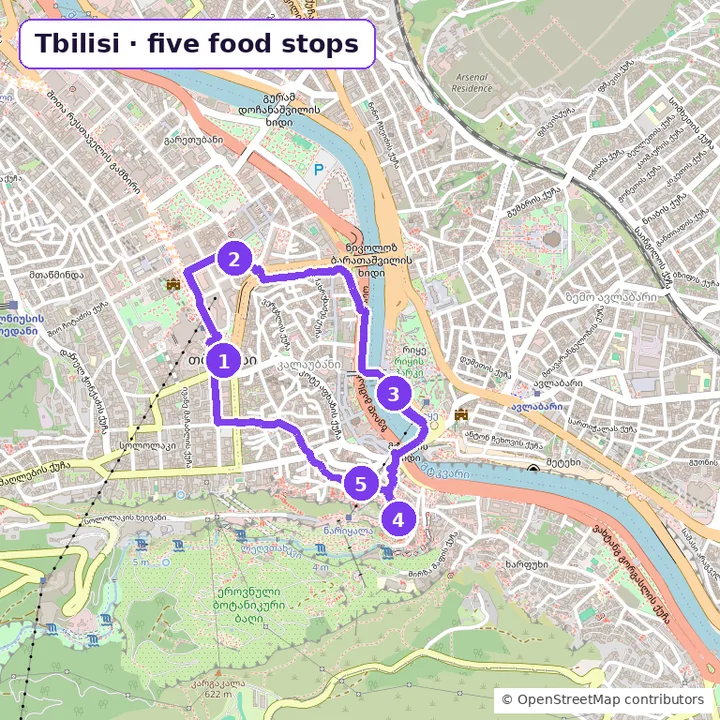
Run for a food day in Tbilisi. The spacing rule did the heavy lifting: without it the model packed three meals into five hours.
What comes back. Five food blocks with walking legs between them, dishes explained rather than just named, and a booking route for each place.
Where it stumbles:
1. Ratings are quoted without weight. A 4.9 from 40 reviews is weaker than a 4.7 from 9000 — ask for review counts, not just scores.
2. Booking links are the least reliable part. Many places take reservations only by phone or through an aggregator; ask which one specifically.
3. Portion sizes are ignored. Five stops sounds fine on paper and is a lot in practice — ask it to mark which stops are tasting-sized.
4. Dietary restrictions get respected in the venue choice but not always in the dish list. Reread that part yourself.
More prompts

Jack-o-lantern still life by candlelight, no people
Witch apothecary shelf: jars, herbs, candle stubs

Victorian vampire portrait from your selfie, candlelit manor

Autumn Pumpkin Field Portrait at Golden Hour From a Selfie