Family day out itinerary: short blocks, toilets marked, one hands-on stop every two hours
A prompt for a day in a city with children: blocks under 40 minutes, food and toilets marked explicitly, warnings about stairs and narrow passages, and a plan for when the child is done.
The prompt
Prompt for ChatGPT, Claude or Gemini — a day in the city with children that survives contact with reality.

Paste as one message:

You are a route planner. Build a [DURATION: 6 hour] day in [CITY: Vienna] with children aged [AGES: 7 and 11]. Start: [POINT: hotel near the ring]. Season: [SEASON: late September]. Must include: [MUST: one place where they can touch things]. Getting around: [TRANSPORT: on foot plus public transport].

No block longer than 40 minutes. Every two hours put a stop where children do something with their hands rather than look. Mark toilets, drinking water and quick food explicitly — those decide the day. Warn about stairs, narrow passages and places without ramps if we have a pushchair. Add a "child is done" plan: what to cut first and where the nearest park is.

Check, don't recall: your memory of opening hours and prices goes stale. Before you place any stop, look it up. Verify opening hours and closing days for every stop, Sunday and Monday separately; verify the restaurant's hours for the exact slot you put it in — many of the best local places serve dinner only and are useless at lunch; verify last admission, it is 30 to 60 minutes before closing. If sources disagree, say so and take the cautious estimate.

Do the arithmetic: blocks plus transfers must add up exactly to the stated duration. Walking speed in a city with crossings and photo stops is 4 to 4.5 km/h, not 5. Transfers between stops are not free — put them inside the blocks. Leave a 10 to 15 minute buffer and say where it sits and what to cut first if we fall behind. Give the total distance.

Build a loop, not a zigzag: if the route doubles back on itself by more than 300 metres, reorder the stops. Put food where it falls geographically, not across town.

Maps links in this format: https://www.google.com/maps/dir/?api=1&travelmode=walking&origin=LAT,LON&destination=LAT,LON&waypoints=LAT,LON%7CLAT,LON — coordinates, not names, because names are ambiguous. A link takes up to nine intermediate stops, and only three when opened in a mobile browser, with a 2048 character limit overall, so split a long day into segments of three. Transit legs get their own links with travelmode=transit.

Never invent: real links only, prices and hours only from sources, and if you cannot find something write "check on site" instead of a plausible number. If something does not fit the time, say so and name what to cut.

Put it all in a Word document and attach the file. In chat give a short summary and the two or three things that need booking ahead. Do not retell the document.
What you get
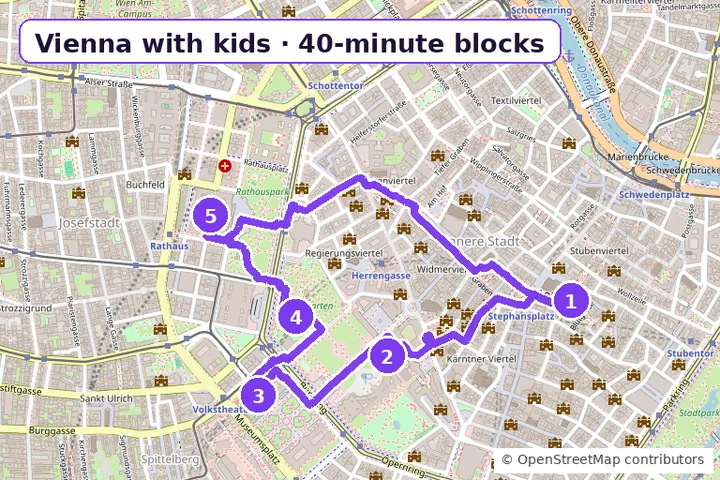
Run for a day in Vienna with two children. The 40-minute ceiling is what makes it work — without it the model plans adult blocks of an hour and a half.
What comes back. Short blocks with a hands-on stop every two hours, toilets and water marked on the timeline, and a cut-first list at the end.
Where it stumbles:
1. It calls things "interactive" generously. Check what the child actually does there: press a button or watch a screen.
2. Pushchair accessibility is guessed rather than verified. For anything with stairs, confirm on the venue's own site.
3. Queue times are missing entirely. For a popular museum add 20 to 30 minutes yourself or book a slot.
4. It rarely plans a proper sit-down break. Ask for one long stop in a park with food nearby — that saves the second half of the day.
More prompts
Haunted mansion interior: staircase hall, dust, one shaft of moonlight

Werewolf mid-transformation portrait from your selfie

Calavera sugar skull face paint portrait from your photo

Halloween thriller still from a selfie: rainy alley, one lamp