One-day city itinerary as a Word document you can walk without signal
A prompt that turns a free day in an unfamiliar city into a working plan: opening hours checked against your arrival slot, timings that add up, a loop instead of a zigzag, and a document that survives roaming.
The prompt
Prompt for ChatGPT, Claude or Gemini — a day in a city that does not fall apart at the second stop.

Paste as one message:

You are a route planner. Build a [DURATION: 8 hour] walking day in [CITY: Prague]. Start and finish: [POINT: hotel near Wenceslas Square] — work out the coordinates yourself and put them in the document along with the district name. Travel date: [SEASON: late September]. Pace: [PACE: moderate]. Must include: [MUST: lunch with local food]. Leave out: [SKIP: museum interiors].

Check, don't recall: your memory of opening hours and prices goes stale. Before you place any stop, look it up. Verify opening hours and closing days for every stop, Sunday and Monday separately; verify the restaurant's hours for the exact slot you put it in — many of the best local places serve dinner only and are useless at lunch; verify last admission, it is 30 to 60 minutes before closing. If sources disagree, say so and take the cautious estimate.

Do the arithmetic: blocks plus transfers must add up exactly to the stated duration. Walking speed in a city with crossings and photo stops is 4 to 4.5 km/h, not 5. Transfers between stops are not free — put them inside the blocks. Leave a 10 to 15 minute buffer and say where it sits and what to cut first if we fall behind. Give the total distance.

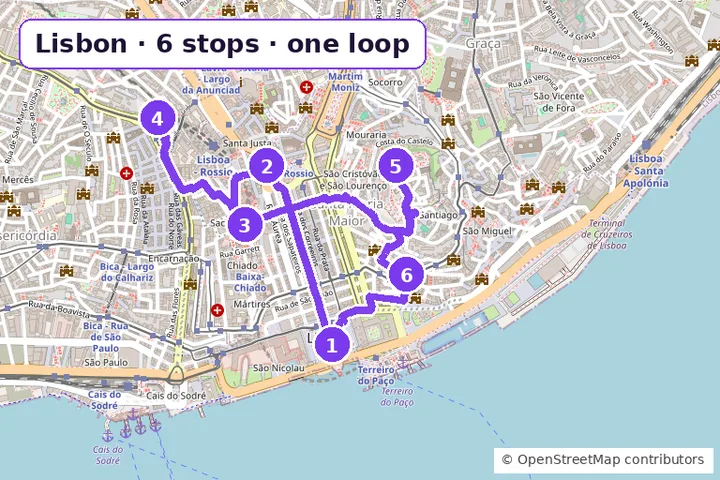
Build a loop, not a zigzag: if the route doubles back on itself by more than 300 metres, reorder the stops. Put food where it falls geographically, not across town.

Maps links in this format: https://www.google.com/maps/dir/?api=1&travelmode=walking&origin=LAT,LON&destination=LAT,LON&waypoints=LAT,LON%7CLAT,LON — coordinates, not names, because names are ambiguous. A link takes up to nine intermediate stops, and only three when opened in a mobile browser, with a 2048 character limit overall, so split a long day into segments of three. Transit legs get their own links with travelmode=transit.

Never invent: real links only, prices and hours only from sources, and if you cannot find something write "check on site" instead of a plausible number. If something does not fit the time, say so and name what to cut.

Put it all in a Word document and attach the file. In chat give a short summary and the two or three things that need booking ahead. Do not retell the document.
What you get
This prompt grew out of a failed day: a beautiful route where the market shut at 17:00, the restaurant only served dinner, and the way back crossed the same street twice.
What comes back. A summary table of time, stop and duration; blocks headed like "11:00 – 11:40 · Name"; transfers as separate lines with an explicit "from → to"; the lunch block with address, hours, average bill and two fallbacks nearby. Then maps links split into segments and a practical notes section.
Where it still stumbles:
1. With search switched off the model answers from memory. If there are no source links behind the opening hours, it did not check them and the whole timing is a guess.
2. Coordinates for landmarks come out right, small cafes are sometimes a block off. Open the link before you leave and see where the pin actually sits.
3. The sums do not always close on the first try. Check them: if the numbers do not add up, ask for a rebuild rather than a fudge.
4. A restaurant can simply be gone — no model learns that before you do. That is why the prompt demands two fallbacks nearby.
More prompts

Gothic haunted house at night: fog, moonlight, warm windows

Calavera sugar skull face paint portrait from your photo

Halloween flat lay: mask, candles and pumpkins on dark linen
Family day out itinerary: short blocks, toilets marked, one hands-on stop every two hours