To put yourself in a Halloween photo, upload one clear front-facing selfie to Gemini or ChatGPT and describe the costume, the light and the camera in that order. Keep an explicit face-preservation line in every prompt. For scenes with no person in them, Midjourney gives a cleaner picture. Person shots and scene shots are different jobs, and mixing them up is why so many results show a stranger in a costume.
Ten prompts follow. Eight have full prompt pages on this site, with a longer version and a description of what you get. Two you'll only find here. None of them names a film character — generators block those names far more often than you'd expect.
The source photo decides the result
Most prompt lists start with the prompt. That's backwards. If the model can't read your face, no amount of wording will save the image: it draws someone who isn't you, and you blame the prompt.
- Face the camera. Straight on, or turned slightly. A profile shot makes the model invent half your face, and it will.
- One soft light. A window on a cloudy day is ideal. Midday sun and phone flash burn out the skin texture the model needs.
- Nothing across the face. No sunglasses, no hair over the eye, no hand on the chin, no shadow on a cheek.
- Head and shoulders fill the frame. A face forty pixels wide carries no detail. Crop before you upload.
- Neutral expression. Extreme expressions get redrawn, and that redraw is where you stop looking like you.
- No filter, no beauty mode. The phone smoothed the skin once; the model smooths it again, and the result ends up looking like plastic.
Keep that file and always start from it. Never use the model's output as the source for the next attempt: two generations from the real photo, the face isn't yours anymore.
The order the blocks go in
Write the blocks in this order and the model actually follows it: face rule, costume, place, light, camera, limits. The face rule goes first because whatever comes first carries the most weight. If it still drifts after two or three tries, repeat that sentence as the last line too — first for weight, last as a reminder. The camera block turns a description into a photograph: focal length (85mm for a portrait, 35mm when you want room around the person), depth of field, grade.
Flags are Midjourney syntax, and only Midjourney reads them. Gemini and ChatGPT ignore --ar and --no, so there you write the framing in words ("vertical 4:5 frame") and the exclusions in plain text. In Midjourney, --no subtracts the whole phrase, not the idea — --no cartoon people can delete the people you asked for. Keep each negative to a single word inside one --no list: --no people, text, watermark. A repeated parameter is rejected, so --no text --no watermark fails.
Ten Halloween prompts
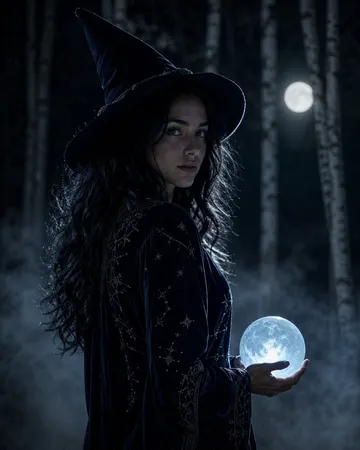
1. Celestial witch portrait. Moody rather than scary, and it almost never trips a filter. Card: Celestial witch portrait from a selfie.
Use the uploaded photo as the only face reference. Keep the exact features and age; do not smooth or slim the face.
The same person as a celestial witch in a [FOREST: pine / birch / oak] forest at night. Wide-brimmed hat, dark gown with a faint star-map pattern, a dim glass orb lighting the face from below.
[MOON: full / crescent] moon behind the shoulder for a thin rim light. Fog at ankle height, palette [PALETTE: deep blue and silver].
85mm, shallow depth of field. Vertical 3:4 frame.
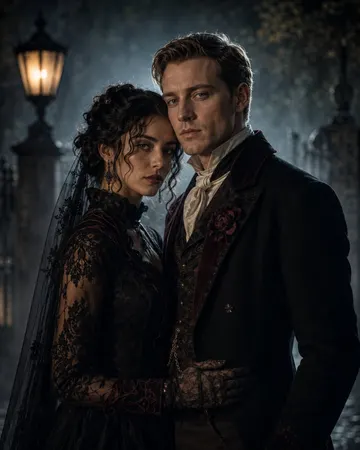
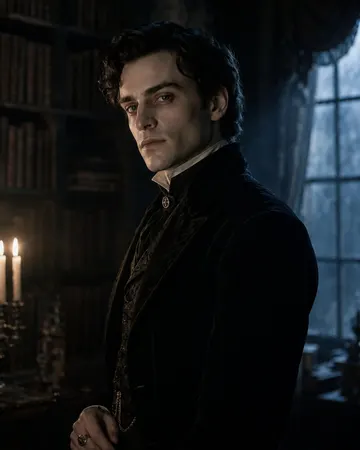
2. Victorian vampire portrait. Reads as expensive because the effect comes from candlelight and fabric, not teeth. Card: Victorian vampire portrait from a selfie.
Use the uploaded photo as the only face reference. Keep the exact features, age and skin texture.
Half-length portrait of the same person as a Victorian aristocrat in a manor at night. High stand collar, [COAT: black / deep red] velvet coat, silk cravat.
A candelabra of [CANDLES: three / seven] candles camera-left, warm and low, falling off into darkness on the right. [BACKDROP: oak paneling / red drapery] behind, out of focus.
85mm, f/2, cool shadows, warm highlights. Vertical 4:5 frame.
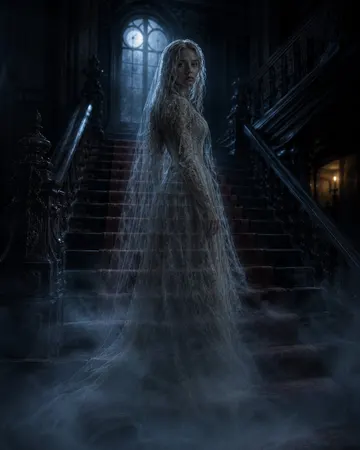
3. Ghost bride on a moonlit staircase. Translucency reads instantly, even at thumbnail size. Card: Victorian ghost bride on a moonlit staircase.
Use the uploaded photo as the only face reference. Keep the exact features, age and skin texture.
The same person as a Victorian ghost bride on a [STAIRS: wooden / marble] staircase in a dark house. Lace gown and veil, [TRANSPARENCY: slight / strong], hem dissolving into mist on the steps.
Cold moonlight through a tall window camera-right, dust in the beam. The face stays solid and lit; only gown and veil are translucent.
[LENS: 35mm wide / 85mm tight], desaturated blue grade. Vertical 3:4 frame.
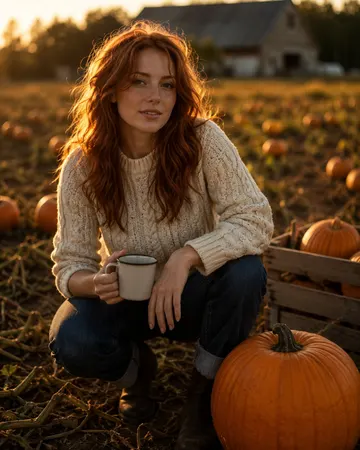
4. Pumpkin field at golden hour. A Halloween photo with nothing scary in it — the one you can post for family. Card: Pumpkin field portrait at golden hour.
Use the uploaded photo as the only face reference. Keep the exact features, age and skin texture.
The same person among pumpkins in an open field, late afternoon in October. [OUTFIT: knitted sweater / denim jacket] in [COLOR: mustard / rust / cream], hay bales and [GROUND: dry leaves / corn stalks] nearby.
Low sun behind the subject, warm rim light on the hair, gentle fill on the face. No horror elements, no glowing carved faces.
85mm, f/2.2, warm grade. Vertical 4:5 frame.
5. Couple portrait from one photo. One shared key light does more here than matching costumes. Card: Halloween couple portrait from one photo.
Use the uploaded photo as the only reference for both faces. Keep each face exactly as it is; do not merge or swap them.
Both in matched [THEME: gothic / 1920s / masquerade] costumes at a night party, standing close, the one on the [SIDE: left / right] half a step forward.
One warm key light camera-left on both faces, cool [BACKLIGHT: string lights / window lamps] behind. Both faces visible, no mask on either, no third person.
35mm, f/2.8, both in focus. Wide 3:2 frame.
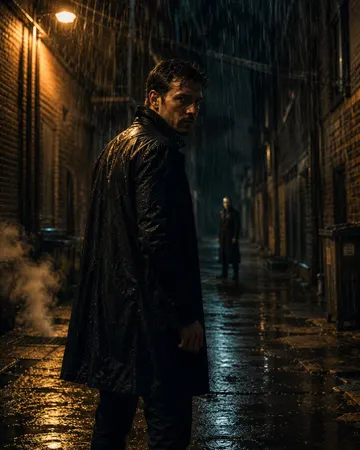
6. Thriller still in a rainy alley. A film frame rather than a costume photo; the light carries it. Card: Thriller still: rainy alley, one lamp.
Use the uploaded photo as the only face reference. Keep the exact features, age and skin texture.
Film still: the same person about [DISTANCE: 6 feet] from the camera in a narrow wet alley at night, in a [COAT: long coat / raincoat], hands visible and empty.
One [LAMP: sodium / mercury] streetlamp above and behind, a hard shadow on the wall, rain streaks lit by the lamp, puddles reflecting it. Suspense, not violence: no blood, no weapons.
[LENS: 35mm / 50mm] anamorphic look, deep shadows, heavy grain. [FRAME: wide 16:9 / vertical 4:5].
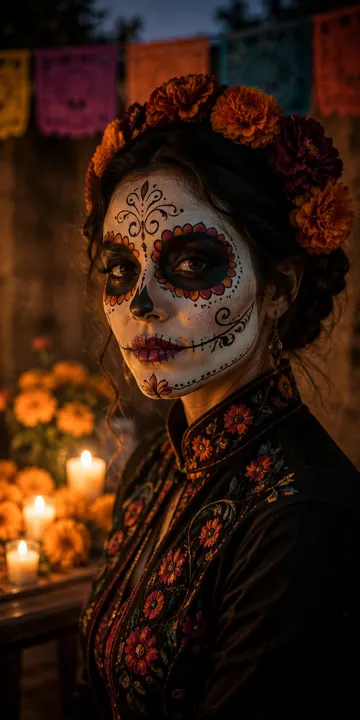
7. Calavera face paint portrait. Color instead of darkness, and forgiving if all you have is a phone selfie. Día de Muertos isn't Halloween — it's a living remembrance holiday, not a costume, so keep it celebratory, not scary. Card: Calavera sugar skull face paint portrait.
Use the uploaded photo as the only face reference. Keep the exact bone structure, eye shape and age. The paint sits on top of the real face: do not replace it with a skull.
Decorative calavera paint: white base, fine black outlines around the eyes, [MOTIF: flower / lace / dot] shapes on cheeks and forehead, [ACCENT: marigold orange / magenta] accents.
[BACKGROUND: marigolds / paper flags] and lit candles behind, out of focus. Candlelight from below-left, soft fill from the front.
85mm, f/2, rich color, clean lines. Vertical 4:5 frame.
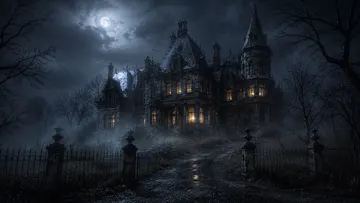
8. Gothic haunted house at night. A header image or an invitation backdrop; no photo of anyone needed. The only Midjourney prompt here, so the only one with flags. Card: Gothic haunted house: fog, moonlight, warm windows.
A [STYLE: Victorian / Second Empire / Queen Anne] mansion at night, seen from the overgrown front path. Steep roof, one turret, broken porch railing, [TREES: bare oaks / dead pines] on both sides.
Ground fog to knee height, full moon behind the roofline, [WINDOWS: three / five] windows lit warm amber, everything else deep blue.
Wide architectural shot, 24mm, long exposure.
--ar 16:9 --no people, text, watermark
9. Group of friends without merged faces. Only in this guide. The staggered line is what keeps the faces apart.
Use the uploaded photo as the only reference for the faces. Keep every face exactly as it is: do not merge faces, do not copy one face onto another, do not add people.
[COUNT: three / four] friends in costume on a porch at night: [OUTFITS: witch / vampire / scarecrow], one per person, all different.
Staggered depth, each person half a step behind the one before, every face visible, no overlapping heads.
A warm [KEY LIGHT: porch lamp / lantern] above the door, cool blue night behind. 35mm, f/4 so every face stays sharp. Wide 3:2 frame.
10. Party invitation layout. Only in this guide. When the image has to carry text, ask for one short line — long text is where image models fall apart.
Vertical invitation card, [SIZE: 5x7 inch] proportions. Background: dark [COLOR: plum / charcoal / forest green], paper texture, thin gold border.
Center: one line of large text reading exactly "[PARTY NAME]", below it a smaller "[DATE AND TIME]". No other text on the card.
Small gold line-art in the corners: a moth, a candle, a crescent moon.
Flat illustration, high contrast, print-ready. Vertical 5:7 frame.
Which model for which look
If the picture has to contain your real face, you need a model that takes an uploaded photo as an identity reference: Gemini and ChatGPT. Midjourney, Stable Diffusion and Flux draw someone who matches the description, not you.
| Look you want | Best model | What breaks most often |
|---|---|---|
| Costume portrait of yourself | Gemini | Face drifts on the second try; restart from the original photo |
| Two or more people | Gemini | Faces swap, blend or average into one; name who stands where |
| Ghost or translucent effect | Gemini | The face fades too; say that only the gown is translucent |
| House, street, empty scene | Midjourney | Extra windows, impossible roof geometry; simplify the scene |
| Image with readable text | ChatGPT | Letters distort past three or four words; keep it to one line |
What goes wrong, and what to do about it
The three pairs below were generated locally — FLUX.2 klein on an RTX 4070 Super — with no selfie behind them. FLUX can't hold a face from a photo, which is why this guide sends you to Gemini or ChatGPT, and why the two frames in a pair are different invented people: each pair isolates one wording change, not one person before and after (how those runs go).
The generator refuses the prompt. The usual cause is a named film character. Those names are protected and the filters are tuned for them, so the request is blocked before anything gets drawn. Use the archetype instead: a masked figure in a rain-soaked alley, a ghost bride, a scarecrow with a burlap head. You also get a better image, because the model isn't fighting a design it's been told to avoid.
The face isn't yours. Three causes, by frequency: the source photo was too small, dark or turned away; the face rule was missing or buried at the end; or the source was itself a generated image. One fix for all three — crop the original tight, put the face rule first, start again from the real file.
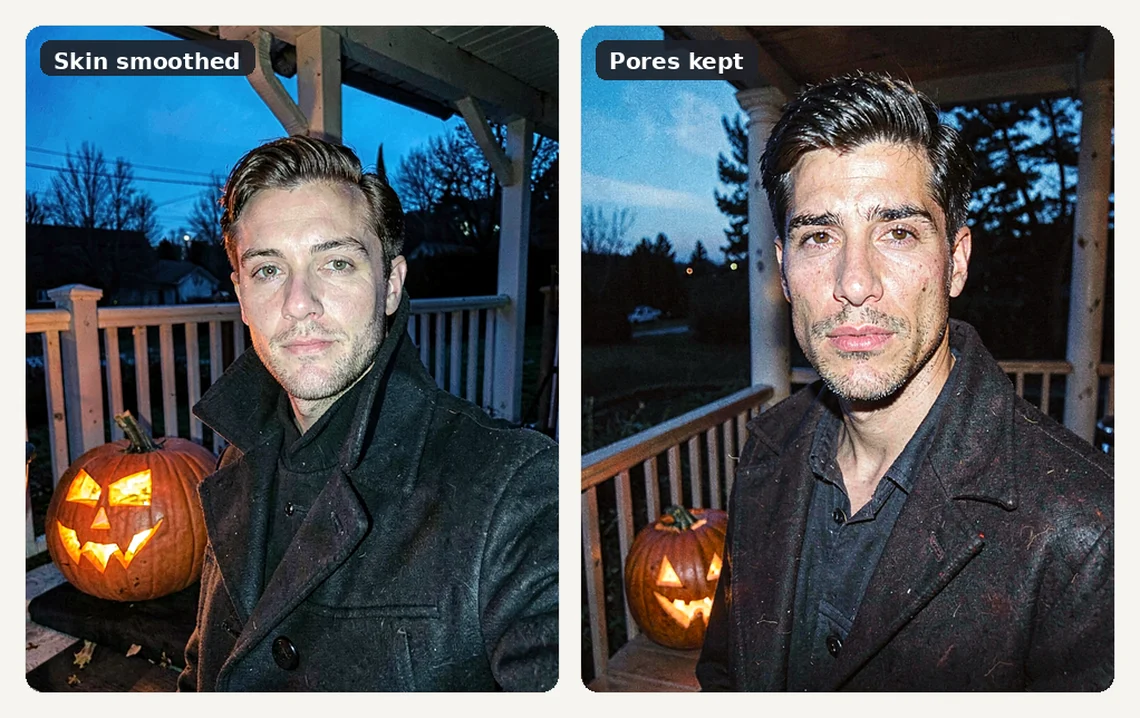
The skin looks like plastic. Models smooth by default, so say the opposite: keep pores and skin texture, don't change the age. Adding "fine 35mm film grain" to the camera block helps too — it gives the model a texture to render instead of a clean gradient.
Hands. Still the weakest part of every model. Avoid them: hands in pockets, one hand on a large object, or a crop above the wrists. If a hand has to show, ask for it empty and relaxed, and expect to run it a few times.
Glasses. Lenses catch the orange of a candle or the green of a party lamp, turn into flat plates, and the eyes disappear. Ask for anti-reflective lenses, move the key light to one side, or take them off.
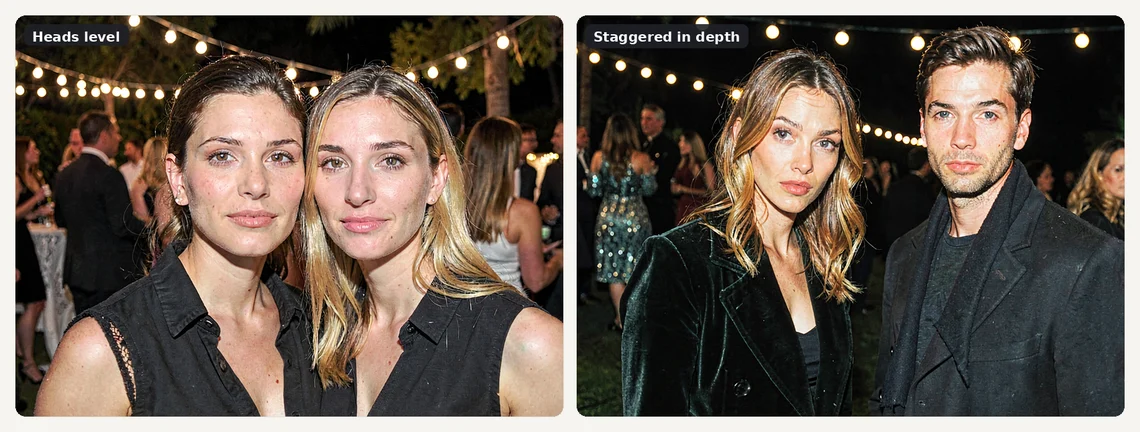
Group shots merge people. The model reads two heads at the same height and close together as one region, and the faces average out. Stagger them in depth, say who stands where, ask for no overlapping heads. Four is the limit.
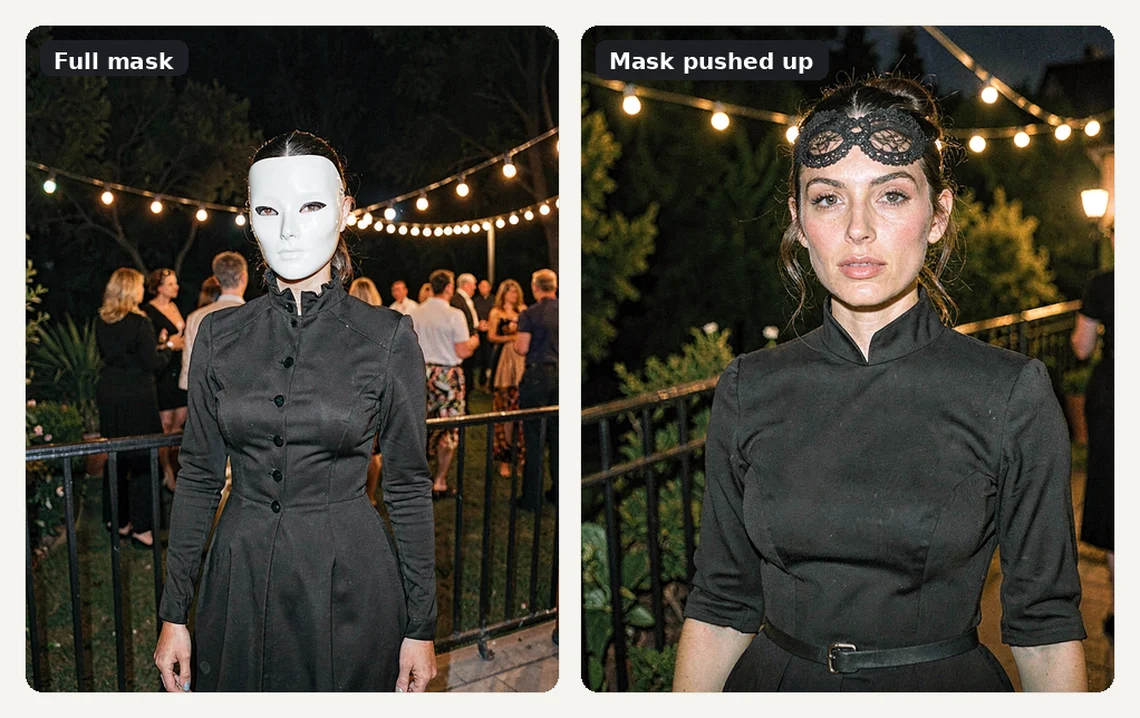
A full mask defeats the point. If the costume covers the face, there's nothing left to preserve and you get a stock photo. Ask for it pushed up on the forehead or in one hand.
Timing: the search peak is in late September
Interest in Halloween AI prompts doesn't peak on October 31. According to Google Trends (US, 2025), it rose through September, peaked in the week of September 28, then fell through October to nothing by early November.
That makes sense: people searching for prompts are making something — a costume plan, an invitation, a profile picture, a post for a client. They need the picture before the event, and starting in the second half of September leaves you time to regenerate, print, or reshoot the selfie.
FAQ
Which model keeps my face best?
Gemini, with ChatGPT close behind. Both take an uploaded photo as an identity reference and hold the features through a costume change. Midjourney, Stable Diffusion and Flux don't hold a face from one photo that way — they draw someone who merely matches your description.
Why did the generator refuse my Halloween prompt?
Almost always because it named a film character: those names are filtered on sight, whatever else the prompt says. Blood, wounds and weapons trigger the same block. Rewrite the idea as an archetype plus a lighting setup and it goes through.
How do I stop the face from changing on the second try?
Start again from the original photo every time; don't ask the model to edit its own output, because each pass drifts further from you. Keep the face-preservation sentence as the first line, and if it still drifts, repeat it as the last line too and crop the source tighter.
Can I use these prompts with a photo of my child?
Only the gentle ones: the pumpkin field portrait and the invitation layout. Don't put a child in a dark or frightening scene. Costume and daylight are fine, fear isn't, and most platforms enforce that too. Check what the service does with uploaded images first.
What aspect ratio should I use?
Use 4:5 or 3:4 for a single-person portrait, 3:2 for two or more people, 16:9 for a cinematic still or a house exterior, 5:7 for a printed invitation. In Midjourney set it with --ar; in Gemini and ChatGPT write it in words.